
How to Fact-Check ChatGPT and Other AI Answers
Introduction
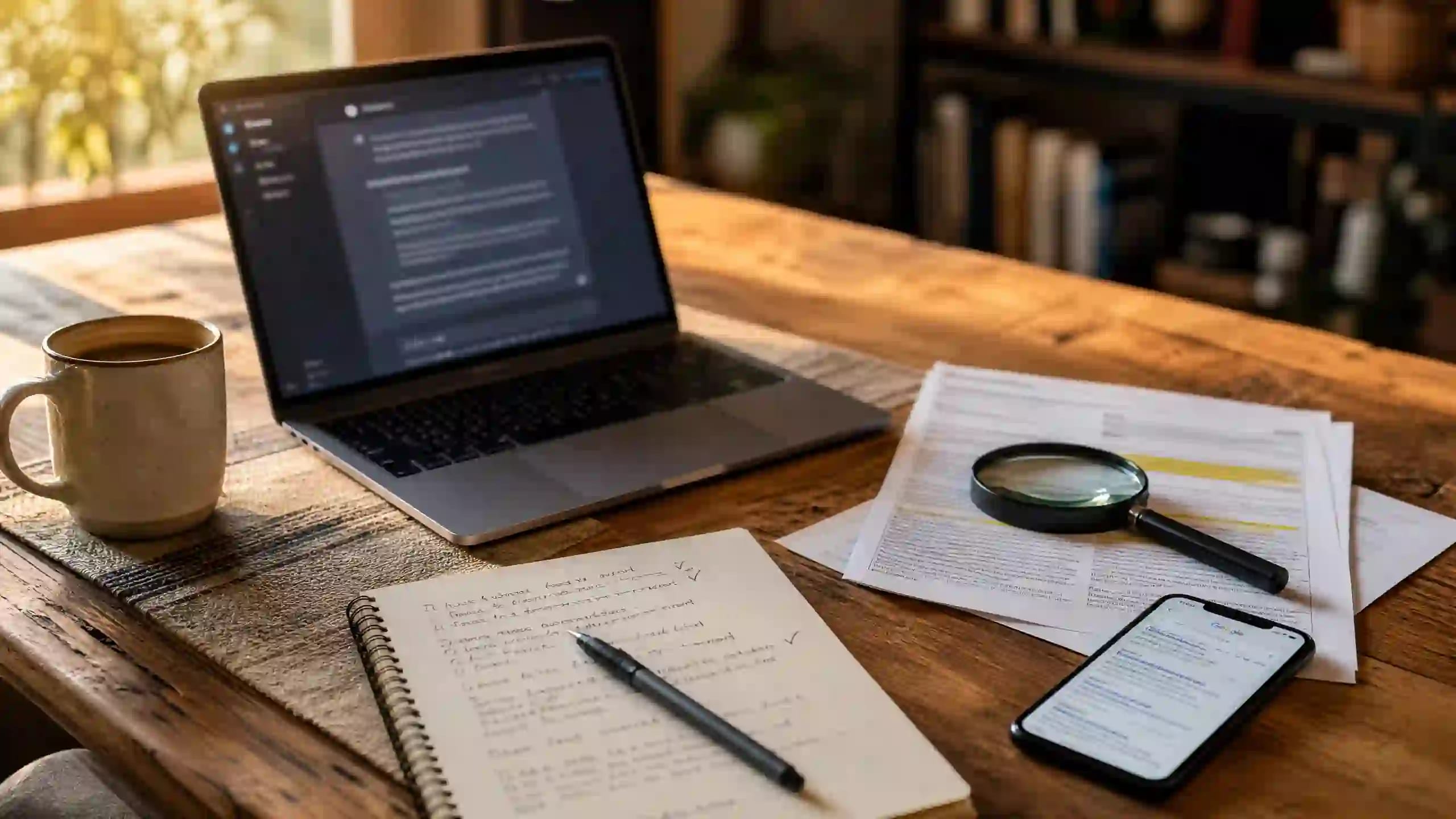
AI tools like ChatGPT, Claude, and Gemini can write a confident, well formatted answer to almost any question in seconds. The problem is that confident does not mean correct. AI models sometimes get names wrong, invent statistics, mix up dates, or state outdated information as if it were current. This is not a reason to stop using AI. It is a reason to learn how to check its work. This guide gives you a simple 7 step method for fact checking any AI answer, then walks through five real examples so you can see the method in action.
Why AI Gets Facts Wrong Sometimes
AI language models are built to predict the most likely next words in a sentence, based on patterns learned from huge amounts of text. They are not connected to a live database of verified facts unless they are specifically using a search tool. This means an AI can produce a sentence that sounds completely correct, in polished, confident language, while actually being wrong. This is sometimes called a hallucination. It also means AI trained on data up to a certain point may not know about anything that happened after that point, unless it searched the web to check.
The 7-Step Method to Fact-Check Any AI Answer
Step 1: Separate the Claim From the Writing
AI answers are often well written, and good writing can make a claim feel more trustworthy than it actually is. Pull out the specific factual claims first, names, dates, numbers, places, and treat each one as something to check on its own, separate from how nicely it was phrased.
Step 2: Identify What Type of Claim It Is
A historical date needs a different kind of check than a current statistic, and a scientific claim needs a different check than a local fact about an institution or a person. Knowing the type of claim tells you where to look for a reliable answer.
Step 3: Search for the Primary Source First
A primary source is the original record, a government document, an official statement, a scientific study, a court record, an institution's own website. Whenever one exists and is reachable, start there instead of a summary written by someone else.
Step 4: Cross-Check With Two or More Reputable Sources
If a primary source is not available, or to confirm what it says, check at least two independent, reputable sources. Independent means they did not simply copy from each other. If several unrelated, credible sources agree, your confidence should go up.
Step 5: Check the Date and Whether the Information Is Current
Some facts change, prices, population figures, office holders, ongoing situations. Look at when your source was published or last updated, and be cautious with any claim that reads like a fixed fact but is actually a moving target.
Step 6: Watch for Confident but Vague Wording
Phrases like "studies show" or "it is widely known that" without naming the study or source are a warning sign, in AI answers and in human writing. A trustworthy claim can usually point to something specific, a named organization, document, or dataset.
Step 7: When In Doubt, Ask the AI to Show Its Sources or Try a Second Tool
If an AI tool has web search enabled, ask it directly to search and cite where a claim comes from. If it cannot, or the answer still feels uncertain, run the same question through a second AI tool or a plain web search, and compare what comes back.
Five Worked Examples of Fact-Checking in Practice
Here is how the 7-step method looks when applied to five very different kinds of claims.
Case Study 1: A Well-Documented Global Event
The claim: The Apollo 11 mission landed the first humans on the Moon on July 20, 1969.
Why it needs checking: Historical events, even famous ones, can get small details scrambled by AI, wrong year, wrong astronaut, wrong sequence of events.
How to verify it:
• Check NASA's own historical archive and mission records, which are a primary source
• Cross check the date and names against major news archives from 1969, or reputable encyclopedic sources that cite NASA directly
• Confirm the exact date and time using more than one independent record, since a single source could contain a typo
Where to look: NASA.gov history pages, national space agency archives, and established encyclopedic references that cite primary mission records.
Case Study 2: A Current Statistic
The claim: The world population is approximately 8.3 billion people, as of 2026.
Why it needs checking: Statistics like population, inflation, or unemployment change constantly. An AI trained on older data may give you last year's number without saying so.
How to verify it:
• Go to the primary data source, such as the United Nations Population Division or a national statistics office
• Check the publish date or update date on any figure you are given
• Compare the number across two or more recognized sources, since small variations are normal but large gaps are a red flag
Where to look: United Nations World Population Prospects, World Bank data, and national census bureaus.
Case Study 3: Sierra Leonean History
The claim: Sierra Leone gained independence from Britain on April 27, 1961, under Prime Minister Sir Milton Margai.
Why it needs checking: AI models sometimes confuse dates or leaders across different African countries that gained independence around the same period.
How to verify it:
• Check Sierra Leone's official government records or national archives where available
• Cross check with established historical references and reputable encyclopedic sources
• Look for the date to be consistent across multiple unrelated sources before treating it as settled
Where to look: Sierra Leone government publications, national archives, university history departments, and reputable historical references.
Case Study 4: A Local Institution
The claim: Fourah Bay College in Freetown was founded in February 1827 and is recognized as the first Western-style university institution in Sub-Saharan Africa.
Why it needs checking: Claims about local institutions are easy for an AI trained mostly on global data to get slightly wrong, especially founding dates and firsts.
How to verify it:
• Check the institution's own official website or published history first, since this is the primary source
• Cross check with the University of Sierra Leone's records, since Fourah Bay College is a constituent college
• Compare against independent historical accounts of West African education to confirm the "first" claim specifically
Where to look: The University of Sierra Leone's official pages, the institution's own historical publications, and independent African history references.
Case Study 5: A Scientific Subject
The claim: Vaccines do not cause autism. This claim has been extensively studied and the original research suggesting a link was retracted.
Why it needs checking: Scientific and health claims carry real consequences when they are wrong, and this is one of the most well studied and most persistently misunderstood topics online.
How to verify it:
• Check primary sources such as major peer reviewed medical journals and public health authorities
• Look specifically for large scale studies and systematic reviews, not single small studies
• Confirm whether any contradicting claim, like the original 1998 study that started this myth, has since been retracted or discredited, and check why
Where to look: The World Health Organization, national public health authorities such as the CDC, and peer reviewed medical journals.
Primary vs Secondary Sources, What's the Difference
A primary source is the original material, a government record, a scientific paper, an institution's own statement, a court document, a direct interview. A secondary source discusses or summarizes a primary source, like a news article, a blog post, or an encyclopedia entry. Secondary sources can be useful and often easier to find, but the strongest fact-checking always tries to trace a claim back to its primary source whenever one exists.
Red Flags That an AI Answer Might Be Wrong
• No specific source is named, just vague phrases like "research shows" or "experts agree"
• The claim involves a very recent event, since AI knowledge can lag behind real time unless it searched the web
• Numbers feel suspiciously round or too neat, real statistics are usually messier than a clean, memorable figure
• The answer changes when you ask the same question a different way, which suggests the AI is guessing rather than recalling a fact
• The claim fits what you already believe a little too perfectly, which is worth extra scrutiny, since AI can also reflect bias back at you
Final Thoughts
AI is a genuinely useful research assistant, but it is not a source of truth on its own. Treat every factual claim from an AI tool the way a good journalist treats a tip, useful as a starting point, worthless until it is checked. The seven steps in this guide take a few extra minutes, and that small habit is what separates people who use AI well from people who get burned by it.
Frequently Asked Questions
Q: Is it safe to trust AI answers for schoolwork or research?
A: AI is a good starting point for research, but any specific fact, date, name, or statistic should be checked against a primary or reputable secondary source before you rely on it, especially for academic work.
Q: Why does AI sometimes sound so confident when it is wrong?
A: AI language models generate text based on patterns, not a built in fact database, so an incorrect answer can be phrased just as smoothly and confidently as a correct one. Confidence in tone is not evidence of accuracy.
Q: Does giving an AI tool access to web search fix this problem?
A: It helps significantly, since the AI can then look up current information rather than relying purely on trained knowledge. It still helps to check the actual sources it cites rather than accepting the summary alone.
Q: What is the fastest way to fact-check a simple claim?
A: Search for the claim using two or three specific keywords, then check whether a primary source, such as an official website or original document, confirms it directly.
Q: How do I fact-check something specific to my own country or community, where global sources are limited?
A: Start with official local sources first, government bodies, national institutions, established local news, then use global sources mainly to confirm dates or cross check details, since local knowledge often lives in local records.
Q: Should I stop using AI tools if they can be inaccurate?
A: No. AI is still a powerful tool for drafting, summarizing, and exploring ideas. The key is treating factual claims as things to verify, not facts to repeat automatically.




Community Discussion
Loading comments...